- Home
- Applications
- Factory automation
Application
Factory automation links over fiber
Inside a plant the fibre is not there for distance. It is there because a drive cabinet is an electromagnetic event, and a copper cable running past it is an antenna.
7 catalogue models · 2 families
01
What the link has to solve
Machine cells are islands: a PLC, a few drives, a vision camera and an HMI, all on a small switch inside the cell. The line cabinet aggregates the cells. Between the two, copper crosses the length of the hall beside motor cables, and that is where a link fails intermittently — not down, just wrong, which is worse.
Fibre answers that, and it also solves the 100 m problem on a long line. The industrial part of the catalogue is built for the cabinet rather than the office: aluminium housings, DIN-rail mounting, a 12~48 VDC input on a Phoenix terminal, and the same form factor across the converter and switch families.
02
Sizing: ports, backbone, power, temperature
Cell level is five to eight ports. LNK-IMC005G (5 x 1000M RJ45) is enough for a small cell; LNK-IMC208G (eight copper plus two fibre) is the version to take where the cell already has a camera or a second panel. The line cabinet needs headroom: ETH-DIMC2416M (16 copper, four SFP) or LNK-GYM7816G-SFP (16 copper, eight SFP) where several cells uplink through one device.
Backbone. Where the line runs at 10G, the catalogue has SFP+ units rather than pure converters: LNK-IMC2X4S8G (8 copper, 4 x 1G SFP and 2 x 10G SFP+) and ETH-IMC2408M (8 copper, 4 x 1G SFP and 2 x 10G SFP+), both switch-shaped devices with 10G uplinks for the ring between line cabinets.
Power. Most plants already have a 24 V rail in the cabinet, and every industrial switch here is printed 12~48 VDC, so 24 V goes in directly. PoE is the exception: the PoE models take 48~57 VDC, so a 24 V rail needs its own supply — the catalogue pairs the 8-port PoE units with NDR-240-48 and the 16-port ones with NDR-480-48.
Temperature. The printed range on the industrial converter families is 0~70 °C. A cell beside a furnace or a weld cell is exactly where that number has to be checked against the ambient, and where it is not printed the answer is confirmed with the quotation.
03
Where it goes wrong
Automation faults are expensive because they stop a line. These are the ones we see most often at commissioning.
- 01 A 24 V rail wired into a PoE switch. It will not come up, and the voltage is printed on the product page before it is printed on the box.
- 02 Unshielded copper inside the cell. The fibre run fixes the link between cabinets; the copper from switch to drive still picks up the noise.
- 03 An IP rating assumed from the word "industrial". The catalogue prints aluminium cases, and IP67 only on the waterproof injector line.
- 04 One SFP type across mixed vendors. The module has to match the far-end port — "works in our switch" is not the same as "links to theirs".
- 05 Fibre routed in the power tray. Bend radius and crush are how a working link becomes an intermittent one three months later.
Recommended models
What we would quote for this link
| Model | Ports | Input power | Transmission distance | Page |
|---|---|---|---|---|
| 5 x 1000M RJ45 | 12~48VDC | 100M | p14 | |
| 8x RJ45+2 x 1000Base-X (SFP, SC, FC, ST ) | 12~48VDC | 550M or 20KM | p16 | |
| 16x10/100/1000T + 4x1000X SFP | 12~48VDC | depends on the SFP module | p22 | |
| 16x10/100/1000T + 8x100/1000BASE-X SFP | 12~48VDC | depends on the SFP module | p22 | |
| 8x10/100/1000T + 4x1G SFP + 2x10G SFP+ | 12~48VDC | depends on the SFP module | p22 | |
| 8 x RJ45+4 x 1000Base-X SFP 2 x 10G Base-SR/LR SFP+ | 12~48VDC | depends on the SFP module | p17 | |
| 4x PoE + 1x1000Base-FX (SFP, SC, FC, ST ) | 48~57VDC | 550M or 20KM | p18 |
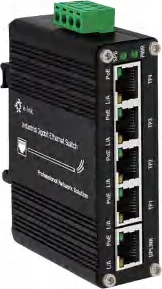
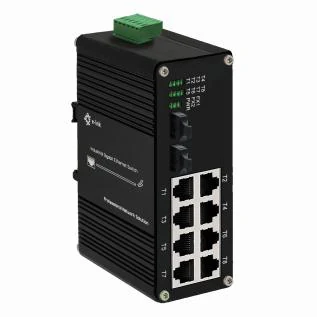
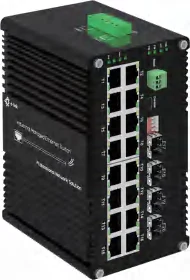
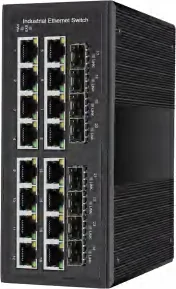
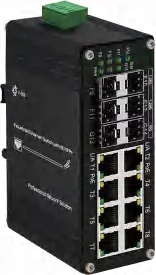
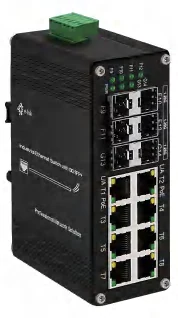
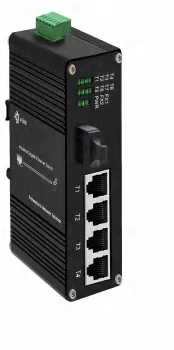
The 10G models are the backbone layer; the 5- and 8-port units are cell level. PoE units are included because vision cameras usually arrive after the cell switch is ordered.
Price, minimum order quantity and lead time are not published for any model — they are confirmed with the quotation. Specifications are transcribed from our factory's catalogue; where a field is not printed there it is left out rather than guessed.
Send the drawing, get the model numbers back
Mark the cameras, cabinets, spans and the power available at each site. We answer with the models, the optics for each span, and the supply each cabinet needs — with the quotation.