- Home
- Applications
- Highway and toll plazas
Application
Highway and toll-plaza links over fiber
A toll plaza is a small data centre with a very long cable. Lane controllers, plate-reading cameras and the plaza LAN sit in a cabinet at the roadside, and the management centre may be 5, 15 or 40 km down the road.
7 catalogue models · 3 families
01
What the link has to solve
Three things separate a roadside link from an office one. Distance: single-mode fibre between plaza and centre is the norm, and the reach is set by the optic rather than the switch. Power: a plaza cabinet has mains through a UPS, while a gantry cabinet may have neither. Environment: a steel box beside a carriageway takes heat, dust and surges that an IT rack never sees.
The topology is usually a chain of cabinets — lane cabinets aggregate into a plaza switch, the plaza switch uplinks to the centre, the centre terminates into the operator core. If the chain has to survive a single cut, the aggregation switches must be managed, because a pair of unmanaged units cannot run a ring.
02
Sizing: ports, distance, power, temperature
Lane level is small: four to eight copper ports plus one or two fibre ports covers a lane controller, a plate camera and a variable message sign. The plaza cabinet is the aggregation point — 16 copper ports with four SFP slots (ETH-DIMC2416M), or 24 with four (LNK-424M-R), the latter printed with an AC 100~240 V input so the UPS feed goes straight in.
Reach is a module decision. Fixed-optics converters print 20 km on single-mode; the SFP models print "depends on the SFP module", and the 136 optical parts listed on this site run from 155 Mb/s to 400G, so a 40 km span is a part number rather than a special build. Where a legacy controller needs RS-232/485/422 across the same span, the serial modem line prints 2KM or 20/40/80KM on the fixed-optics version.
Power splits by cabinet type. Mains cabinets take the AC-input switches. Battery or solar gantry sites take the 12~48 VDC units. Cameras on a gantry are better fed by an IP67 injector at the pole (LNK-IPOE-95W, 90~264 VAC in, IP67 metal housing) than by a DIN-rail unit inside a sealed box that nobody will open again.
Temperature is the line item I would not leave to assumption. The catalogue prints 0~70 °C where it prints a range at all; for a roadside cabinet that is a device rating, not a cabinet guarantee. Ask for the operating range of the exact model — the answer comes with the quotation.
03
Where roadside links fail
These are the faults that come back as "the link worked for a year and then stopped". None of them is a bandwidth problem.
- 01 Unmanaged switches in a ring. A loop takes the plaza down and there is no spanning-tree process to stop it.
- 02 A 20 km optic on a 40 km span. The link attenuates out before the centre; reach, wavelength and fibre count must match at both ends.
- 03 The terminating resistor left off a gantry RS-485 run. The modem lights, the protocol does not.
- 04 Surge protection delegated to the network gear. The fibre is immune; the copper entering the lane cabinet is not.
- 05 Cabinet temperature designed from the device rating. 0~70 °C inside a fanless steel box in July is not 0~70 °C ambient.
Recommended models
What we would quote for this link
| Model | Ports | Input power | Transmission distance | Page |
|---|---|---|---|---|
| 8x10/100/1000T + 4x1000X SFP | 12~48VDC | depends on the SFP module | p21 | |
| 16x10/100/1000T + 4x1000X SFP | 12~48VDC | depends on the SFP module | p22 | |
| 24 x 10/100/1000T + 4 x 100/1000X SFP | AC 100~240V | depends on the SFP module | p22 | |
| 1xRJ45+1xSFP 1000Base-X or 100Base-FX ( auto-detect ) | 48~57VDC | depends on the SFP module | p12 | |
| 1 RJ45 RJ45 input + 1 RJ45 PoE output + 2x M22 waterproof RJ-45 | 90~264VAC | 100M | p29 | |
| SFP | 12~48VDC | depends on the SFP module | p10 | |
| 1x RJ45+1 x SC/ST/FC/SFP 100Base-FX | AC 90~264V | 2KM or 20KM | p34 |
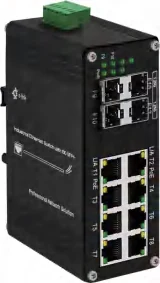
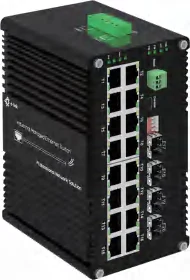
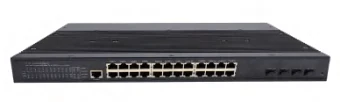
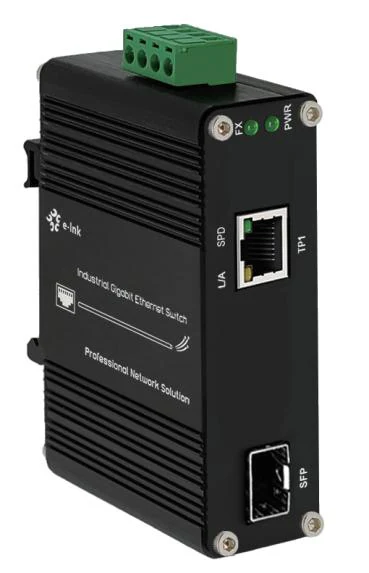
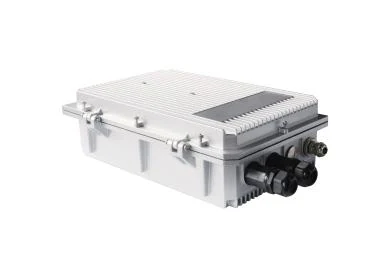
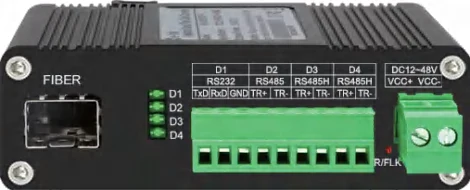
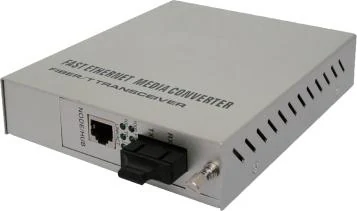
Every figure is copied from the catalogue page cited on the product page. PoE converters are listed here for gantry cameras; the switch models are the aggregation layer.
Price, minimum order quantity and lead time are not published for any model — they are confirmed with the quotation. Specifications are transcribed from our factory's catalogue; where a field is not printed there it is left out rather than guessed.
Send the drawing, get the model numbers back
Mark the cameras, cabinets, spans and the power available at each site. We answer with the models, the optics for each span, and the supply each cabinet needs — with the quotation.