- Home
- Applications
- Smart grid and substations
Application
Smart-grid and substation links over fiber
Distribution automation puts electronics where the electricity is. The reason to use fiber there is not bandwidth — it is that a strand of glass carries no potential.
7 catalogue models · 3 families
01
What the link has to solve
Two different jobs hide under "smart grid". The first is telemetry and protection: ring main units, feeder terminals and RTUs still speak RS-232, RS-485 or RS-422 to the control room, and that serial link has to cross a yard full of switching transients without turning into an antenna. The second is the station LAN: relays, meters and gateways that want Ethernet, often on a ring.
The catalogue has a part for each. The serial fibre modem line (LNK-IRS93) is printed as one SC/ST/FC optical port plus one RS-232/485/422 port, or one SFP slot plus the same serial port. The managed switches cover the station bus. Which one you need is decided by the device at the far end, not by the network drawing.
02
Sizing: distance, ports, power, temperature
Distance. The fixed-optics serial modem prints 2KM or 20/40/80KM — it is the line where 40 km and 80 km appear in the catalogue’s own numbers, which is why it is the first place to look when a feeder is far from the substation. Ethernet spans follow the usual rule: 550M or 20KM on the gigabit fixed-optics units, and the SFP models take their reach from the module fitted.
Ports. One serial channel per RTU, one fibre pair per feeder. Where several feeders terminate in one cabinet, a managed switch with four SFP slots (ETH-IMC408M) alongside the serial modems is a common shape; 16 copper ports with eight SFP slots (LNK-GYM7816G-SFP) covers a larger bay count.
Power. Substation cabinets usually run 24 V or 48 V DC from the station battery, and the industrial units take 12~48 VDC, which covers both without a converter. The DIN-rail supplies in the catalogue (MDR-20-24 at 24 W / 24 V, EDR-75-48 at 75 W / 48 V) are there for cabinets that only have AC; AC-input models such as LNK-1100N&C are printed AC 90~264 V.
Temperature is where the catalogue is silent for most models: 0~70 °C where a range is printed. Cabinet heating and ventilation are normally the buyer’s scope, so ask for the exact model’s range and plan the enclosure around the answer.
03
Where it goes wrong
The serial side is where most of the surprises are, because it looks simpler than it is.
- 01 Expecting the modem to set the protocol. It converts levels, not protocols — RS-485 two-wire and four-wire are different wirings, and the modem has one serial port.
- 02 Treating fibre as surge protection. The strand gives galvanic separation between the two ends; it does not replace arresters on the copper entering the RTU.
- 03 Single-fibre BiDi at one end, duplex at the other. They will not link, and the port LEDs will not tell you which side is wrong.
- 04 155M optics in a port that is not the auto-detect type. The catalogue lists LNK-SFP-155M for the 100/1000X ports, but the port has to accept it.
- 05 An 80 km span with no loss budget. The converter will happily take the module; the link will not close without the calculation.
Recommended models
What we would quote for this link
| Model | Ports | Input power | Transmission distance | Page |
|---|---|---|---|---|
| default SC, ST/FC optional | 12~48VDC | 2KM or 20/40/80KM | p10 | |
| SFP | 12~48VDC | depends on the SFP module | p10 | |
| 1xRJ45+1xSC/ST/FC 100Base-FX | 12~48VDC | 2KM or 20KM | p8 | |
| 2 x PoE+2 x 1000Base-X (SFP, SC, FC, ST ) | 12~48VDC | 2KM or 20KM | p19 | |
| 8x10/100/1000T + 4x1000X SFP | 12~48VDC | depends on the SFP module | p21 | |
| 16x10/100/1000T + 8x100/1000BASE-X SFP | 12~48VDC | depends on the SFP module | p22 | |
| 2 x SFP | DC 5V~12V | depends on the SFP module | p35 |
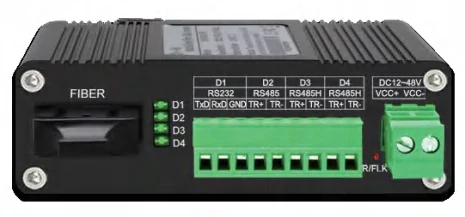
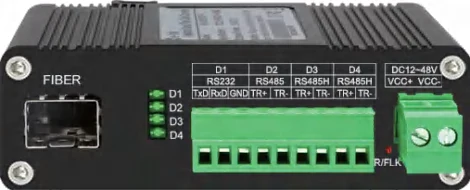
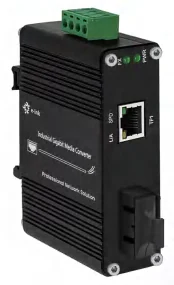
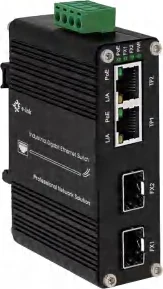
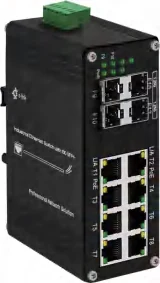
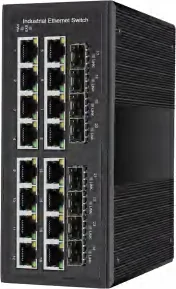
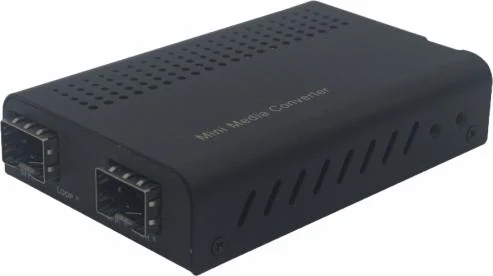
Serial modems are listed first because they are the part most often mis-specified; the Ethernet models are the station-bus layer. Catalogue page numbers are on each product page.
Price, minimum order quantity and lead time are not published for any model — they are confirmed with the quotation. Specifications are transcribed from our factory's catalogue; where a field is not printed there it is left out rather than guessed.
Send the drawing, get the model numbers back
Mark the cameras, cabinets, spans and the power available at each site. We answer with the models, the optics for each span, and the supply each cabinet needs — with the quotation.